Call or WhatsApp us anytime
Mail Us For Support

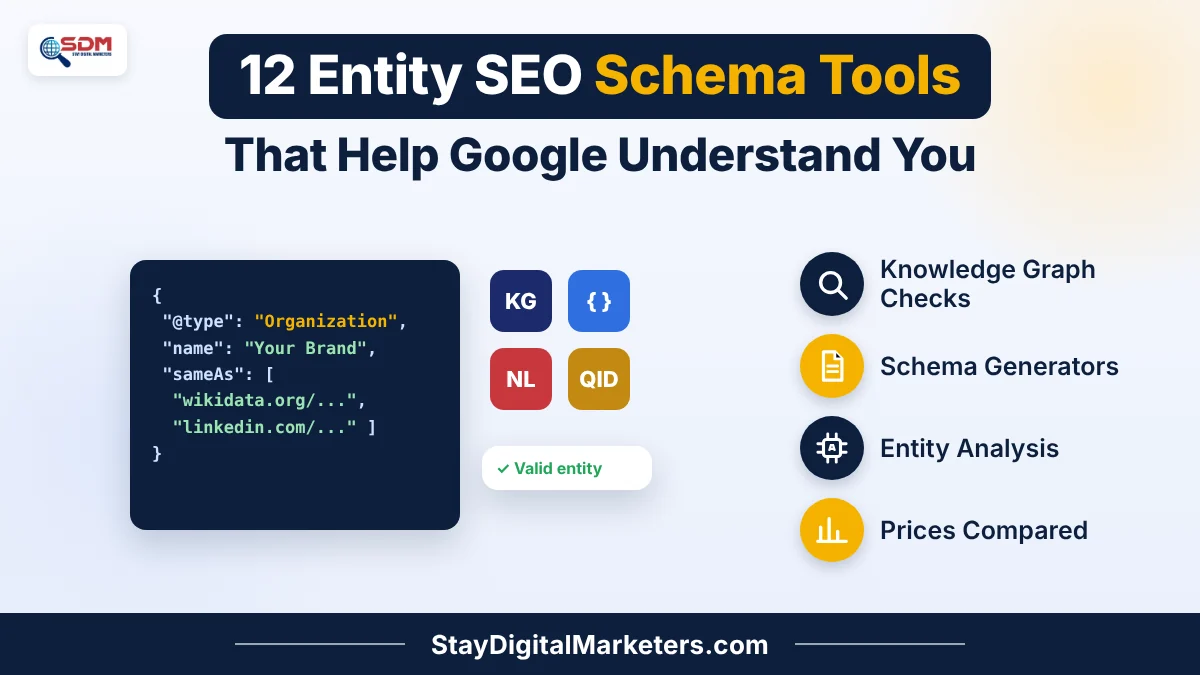
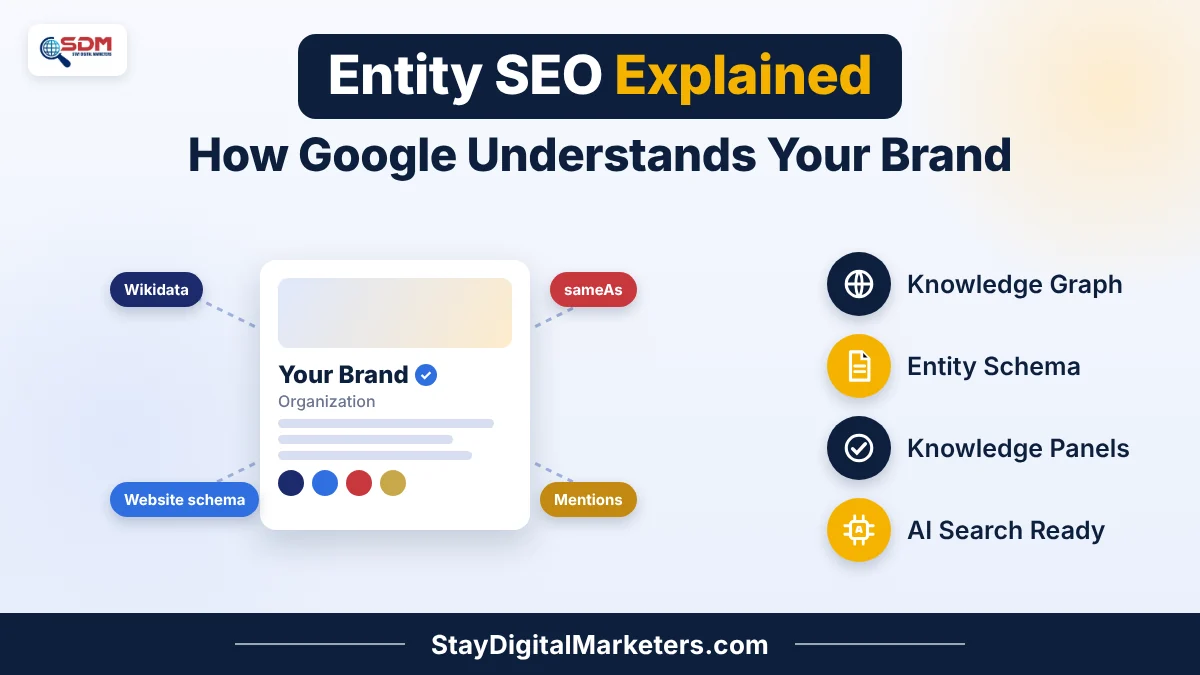
Entity SEO tools help you see whether Google recognises your brand as an entity, describe that entity in structured data, and connect it to trusted sources such as Wikidata. The best stack combines free Google tools for testing with one or two specialist platforms for building and monitoring entities at scale.
This list covers 12 entity SEO and schema tools, grouped by job: checking the Knowledge Graph, writing and testing schema, analysing entities in content, and managing entities across a site. Prices were read from each vendor’s own pricing page in November 2026, and several vendors quote custom prices only.
Key Takeaways
Free Google tools cover testing, Wikidata covers trusted third-party records, and InLinks, WordLift, Schema App and Kalicube Pro cover entity work at scale. The table summarises each tool’s job and entry price.
| Tool | Main job | Entry price (Nov 2026) |
|---|---|---|
| Google Knowledge Graph Search API | Check if Google has an entity ID | Free with an API key |
| Google Rich Results Test | Test schema Google can read | Free |
| Schema Markup Validator | Validate any Schema.org markup | Free |
| Google Cloud Natural Language | Find entities and salience in text | Free demo; usage-based API |
| Wikidata | Structured, referenced entity record | Free |
| Stay Digital Marketers Knowledge Panel Checker | Entity and panel audit | Free |
| Stay Digital Marketers Entity Schema Generator | Person, Organization and sameAs JSON-LD | Free |
| Yoast SEO | Site-wide Organization or Person schema | Free plugin |
| InLinks | Entity-based content, internal links and schema | From $49/month |
| WordLift | Website knowledge graph and AI SEO | Business+ €799/month, billed yearly |
| Schema App | Enterprise schema and content knowledge graph | Custom quote |
| Kalicube Pro | Brand SERP and Knowledge Panel management | Not published; 6-month minimum |
Start with Google’s own Knowledge Graph data, because it shows whether an entity ID exists before any optimisation begins. These tools answer the first question in entity SEO: does Google already know who you are?
Google’s Knowledge Graph Search API returns matching entities for a name, with a Knowledge Graph ID, type, short description and result score. Google describes it as a way to find entities, not a full copy of the Knowledge Graph, and advises against using it as a production database. It needs a free API key from Google Cloud and some technical comfort.
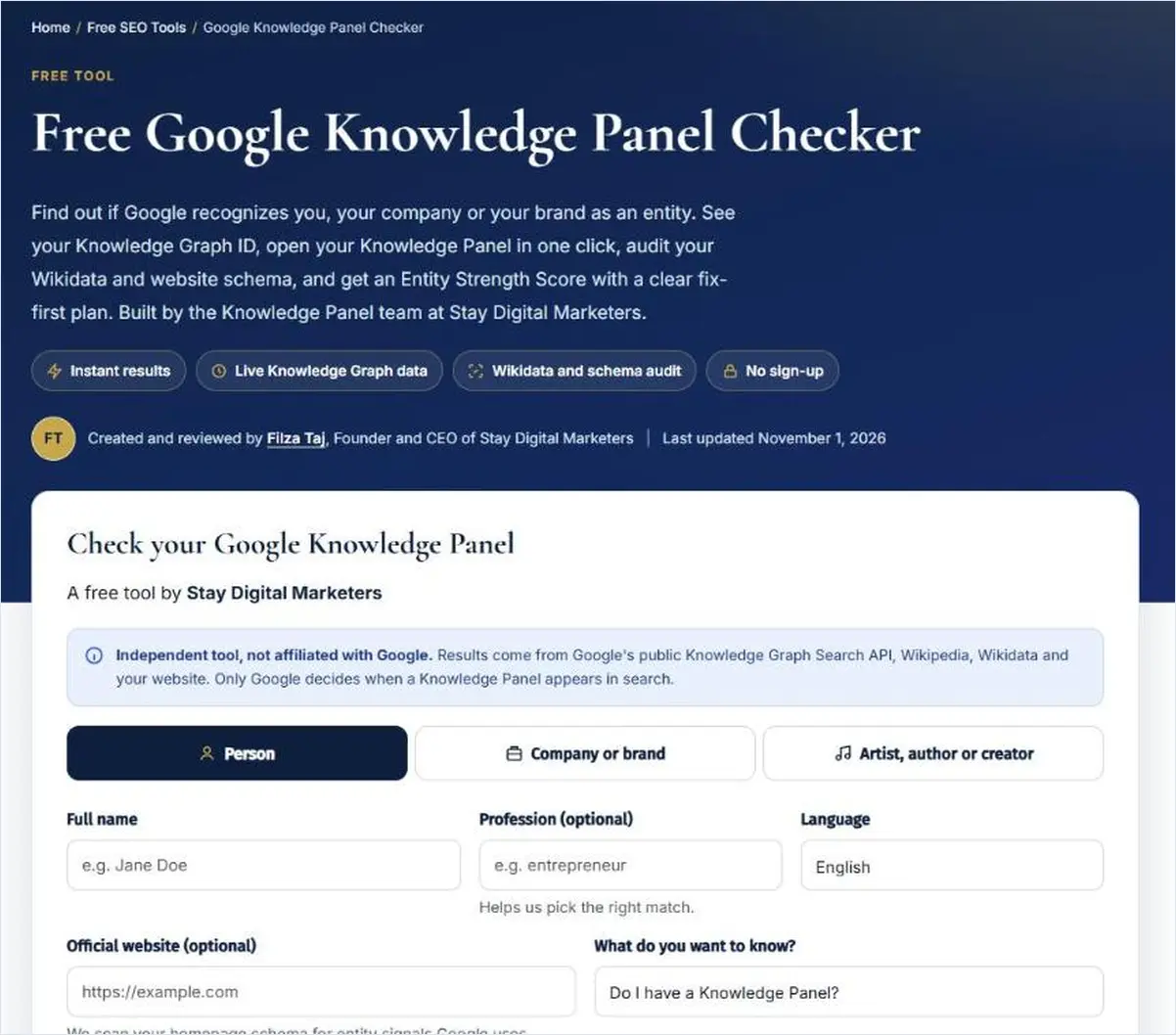
The free Google Knowledge Panel Checker queries the Knowledge Graph Search API, Wikipedia, Wikidata and a website’s homepage schema in one step. It shows whether a person, company or creator has a Knowledge Graph ID, opens the panel in one click and gives an Entity Strength Score with a fix-first plan. No sign-up is needed, which makes it a quick first check before using paid platforms.
Wikidata is a free, structured knowledge base that stores entities as items with unique identifiers called QIDs. Search and AI systems read it widely, so an accurate, referenced Wikidata item is one of the strongest third-party entity signals available. Items need serious, publicly available references; promotional items without them are often deleted.
Use a generator to write Person or Organization schema, then test it with both Google’s and Schema.org’s validators before publishing. Clean markup on one entity home page is the foundation every other tool builds on.
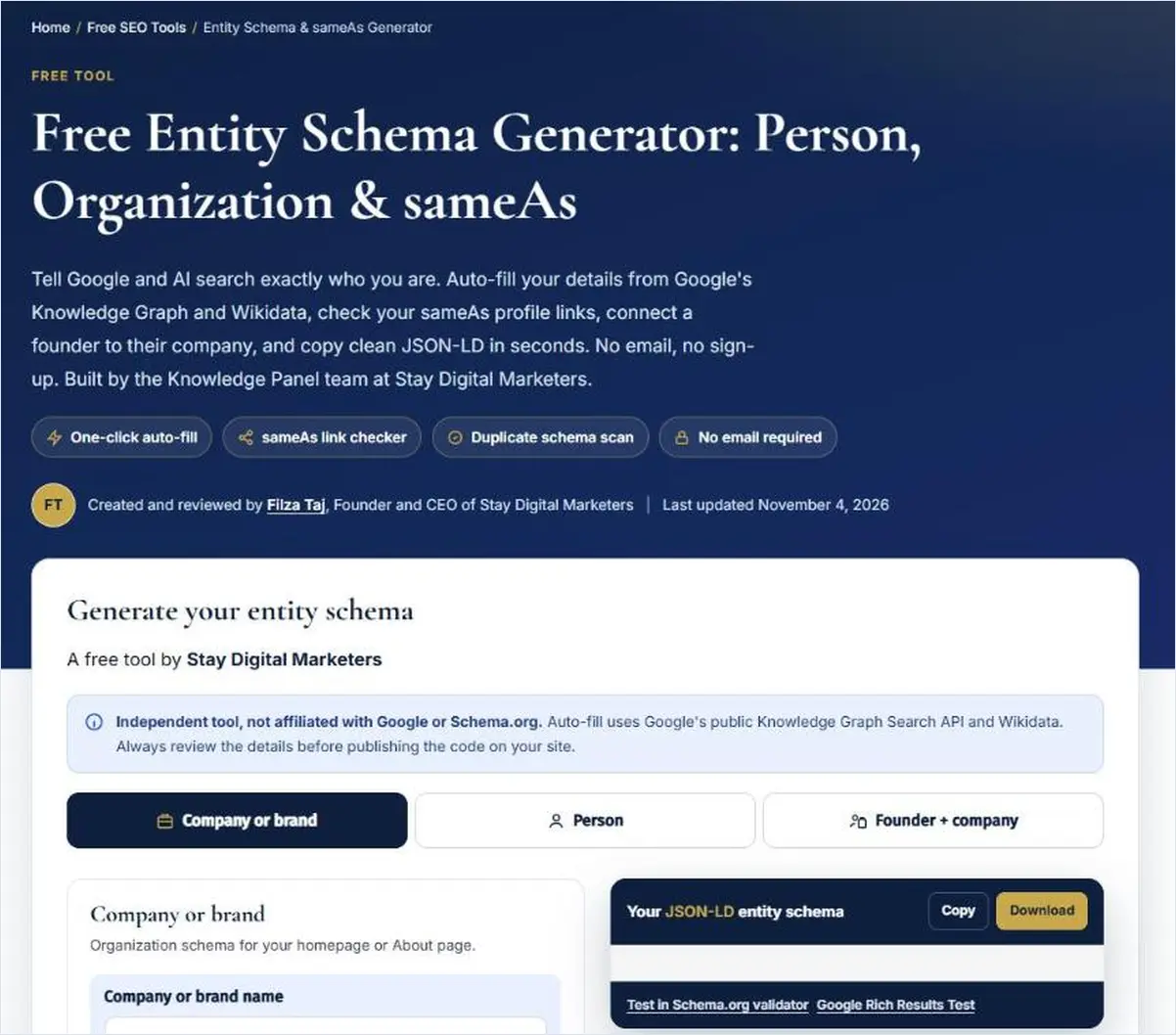
The free Entity Schema Generator builds Organization, Person and founder-plus-company JSON-LD, with auto-fill from Google’s Knowledge Graph and Wikidata. It checks sameAs profile links, scans for duplicate schema and offers one-click links to both validators. It suits founders and small teams who want correct markup without writing code.
The Rich Results Test shows which structured data Google can read on a live URL or code snippet, and flags errors and warnings. It focuses on markup that can produce search features, so it is the right check for how Google itself sees the page.
The Schema Markup Validator, run by Schema.org, checks any Schema.org markup, including types and properties that do not produce rich results, such as sameAs and founder. Use it alongside the Rich Results Test, because entity properties often matter even when they do not create a visible search feature. The Schema.org sameAs definition explains the property as a URL of a reference page that unambiguously indicates the item’s identity.
Yoast SEO’s free WordPress plugin outputs site-wide schema, including an Organization or Person entity set in its site representation settings, with logo and social profiles. Check that the theme or other plugins do not add a second, conflicting Organization block, which is a common cause of mixed entity signals.
Content analysis tools show which entities a page mentions and how central each one is, so you can make sure your brand and topic are clearly connected.
Google Cloud’s Natural Language API identifies entities in text, links many of them to Wikipedia or Knowledge Graph identifiers, and gives each a salience score showing how central it is to the text. The public demo is enough for spot checks on key pages, such as an About page that should make the brand the most salient entity.
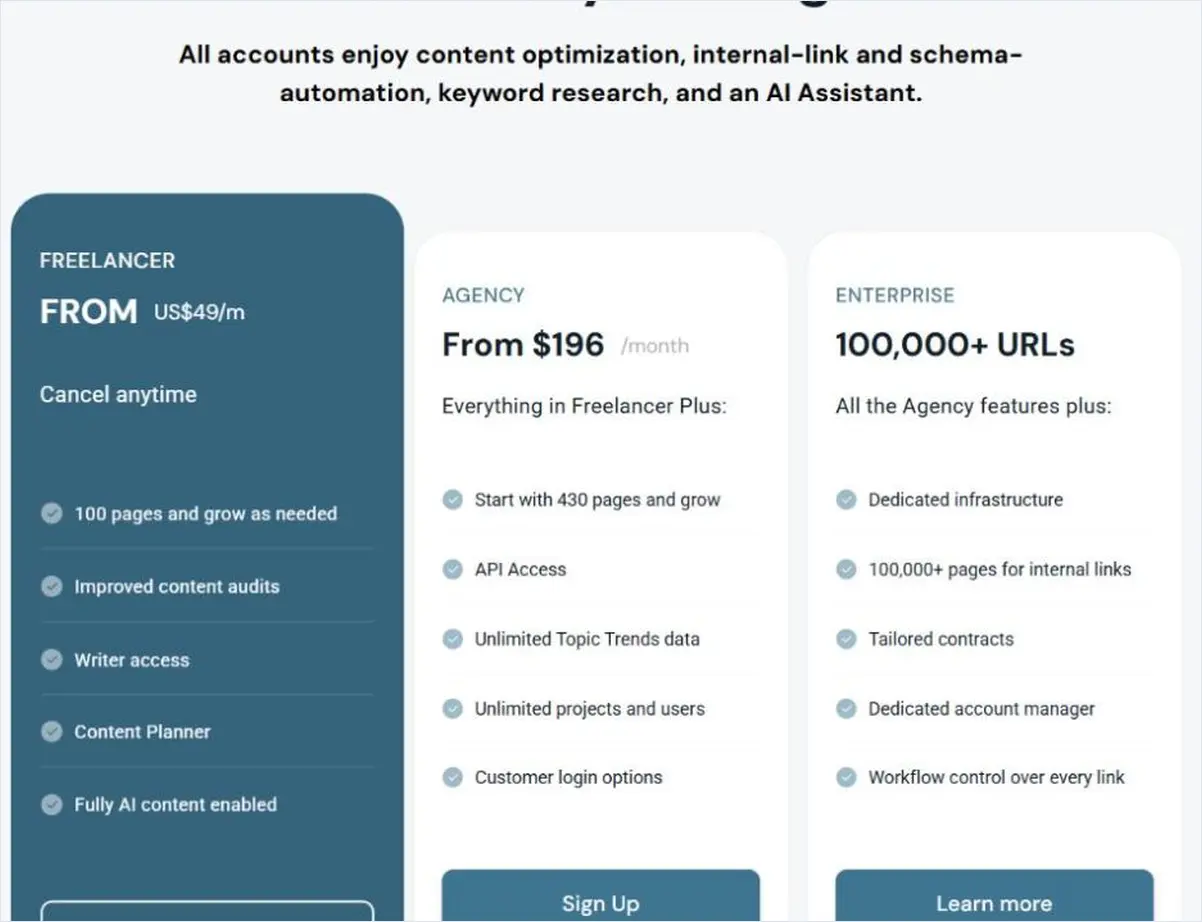
InLinks is an entity-based SEO platform that maps the topics on a site, builds internal links around entities, and automates About and Mentions schema. Its pricing page lists a Freelancer plan from $49 per month for 100 pages, an Agency plan from $196 per month starting with 430 pages plus API access, and an Enterprise tier for 100,000+ URLs, as of November 2026.
WordLift, Schema App and Kalicube Pro suit larger brands that need ongoing entity management, expert support or a dedicated Brand SERP strategy. All three are sold mainly through demos or quotes.
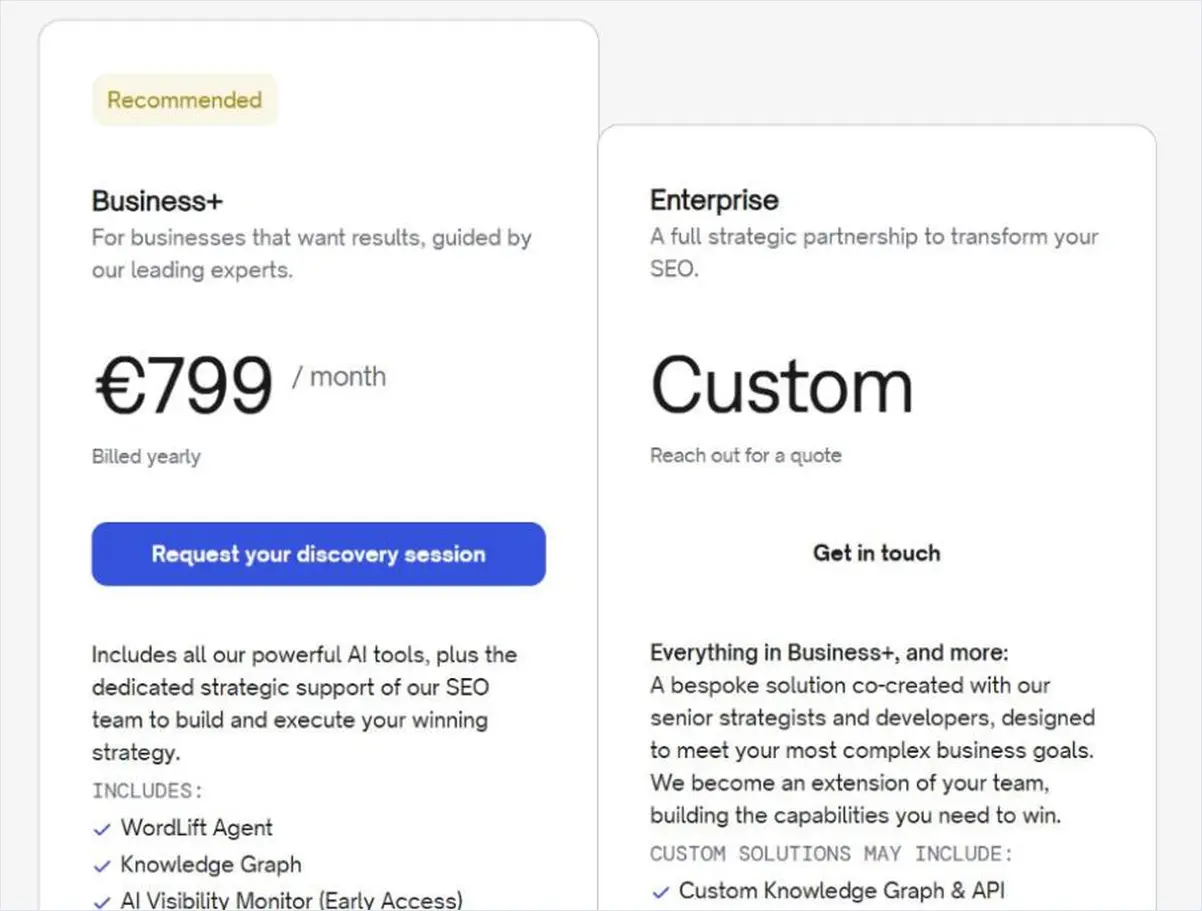
WordLift builds a knowledge graph from a website’s content and adds AI SEO features such as content generation, internal linking and an AI Visibility Monitor. Its pricing page lists Business+ at €799 per month billed yearly, with 2,500 URLs and a dedicated project manager, and a custom Enterprise plan. A free public beta of its Resolve entity-linking API includes 1,000 requests a month.
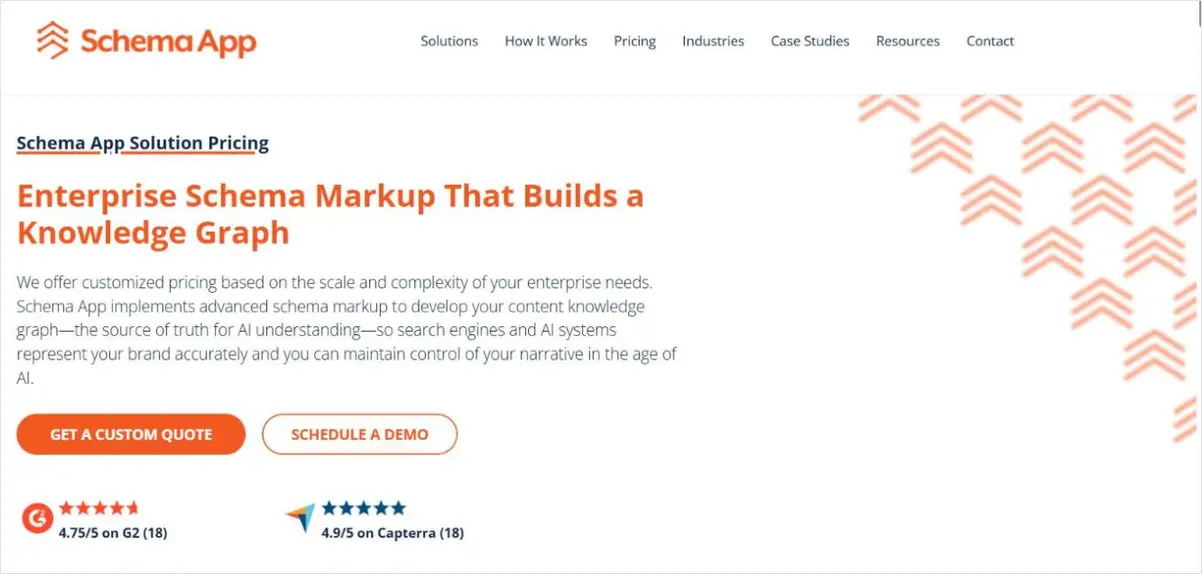
Schema App focuses on enterprise schema markup that forms a content knowledge graph across large websites. Its pricing page states that pricing is customised to the scale and complexity of each site, following a review of goals and existing schema coverage. It suits large organisations with many page types and strict governance needs.
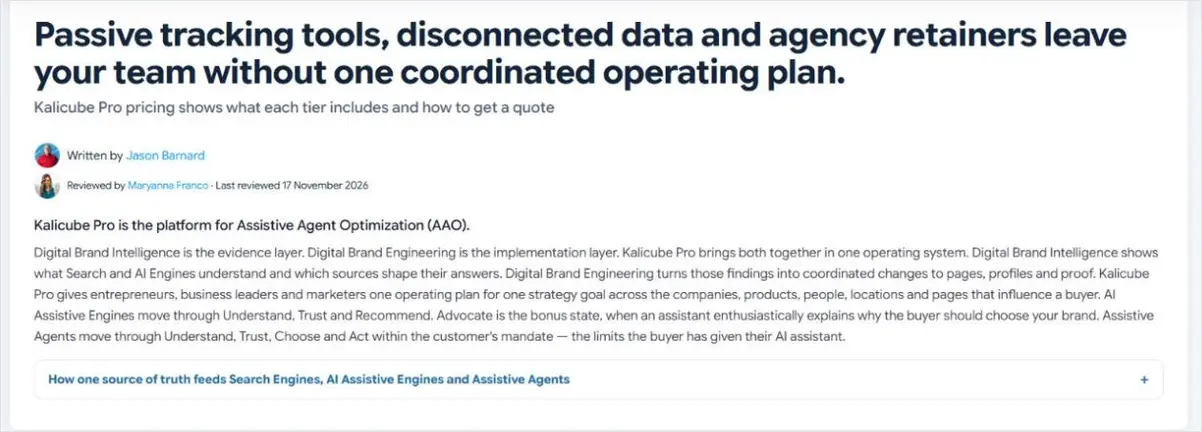
Kalicube Pro, built by Brand SERP specialist Jason Barnard, focuses on how search and AI engines understand and present a brand. Its pricing page describes three tiers, Intelligence, Engineering and Enterprise, sold on a six-month minimum contract, and states that prices are not currently published. The company reports collecting data weekly since 2015 across more than 73 million brands.
The most common mistake is treating a valid schema report as proof that Google understands the entity. Validators confirm syntax, not trust. A perfectly valid Organization block still fails to help when its facts contradict the website, LinkedIn or directory listings.
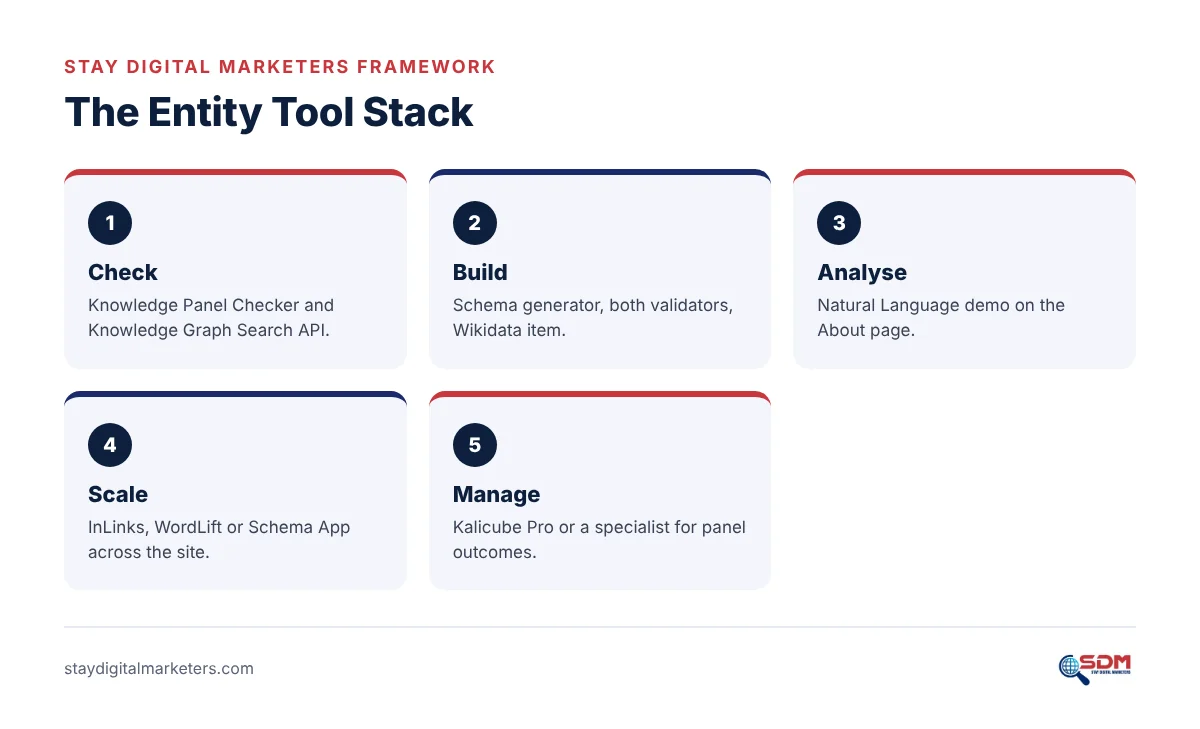
The most efficient pairing for most small brands is one free checker, one free generator and both validators, with Wikidata as the external record. Larger sites add InLinks or WordLift once hundreds of pages need consistent entity markup and internal linking. Enterprise teams with strict governance and many page templates are the natural fit for Schema App. Kalicube Pro and specialist services fit brands whose main goal is a specific Brand SERP or Knowledge Panel outcome rather than site-wide markup.
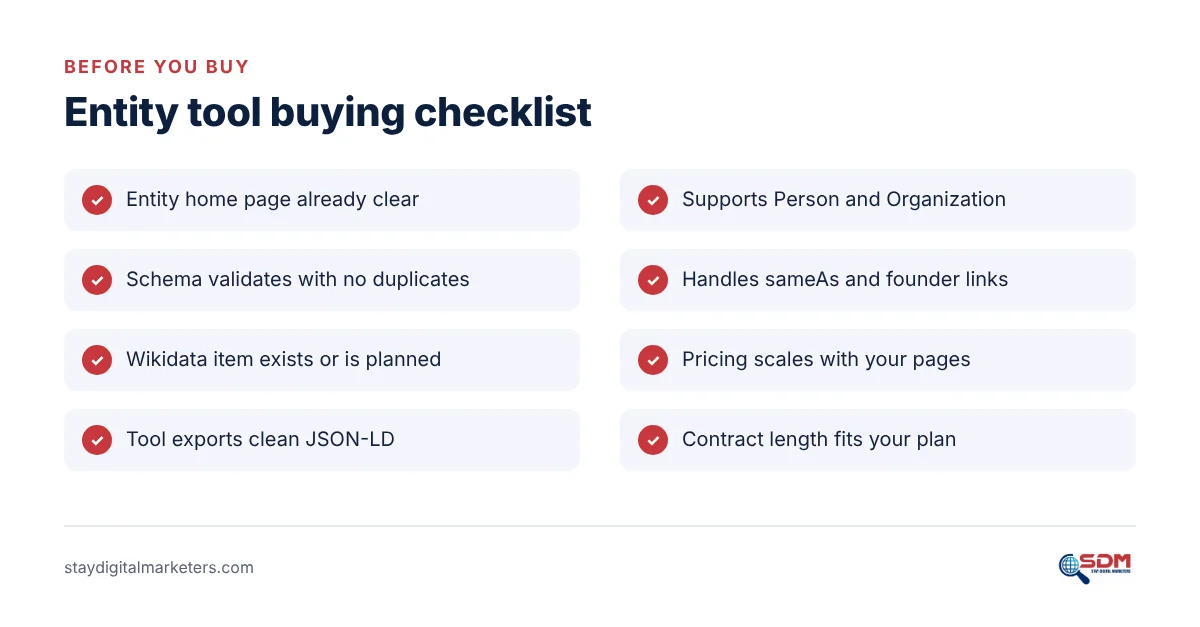
Choose by stage: check first, build second, scale third. The Entity Tool Stack below matches each stage to the tools that fit.
A pattern observed across client work is that brands buy an enterprise platform before fixing their own entity home and schema. The paid tool then reports the same basic gaps a free check would have found. The full method behind these steps is explained in the guide to entity SEO and Knowledge Panels.
More schema options are compared in this list of schema markup generator tools.
Readers focused on AI answers can also see which schema types improve AI search visibility.
Tools for profiles, mentions and citations beyond schema are covered in this list of tools to improve your online entity presence.
Start with free tools that show what Google already knows: the Knowledge Graph Search API or a Knowledge Panel checker, then the Rich Results Test and Schema Markup Validator for your markup. Wikidata is also free and gives your entity a structured, referenced record that many search and AI systems read.
No. Many brands earn panels using free tools, a clear entity home, accurate schema, a referenced Wikidata item and independent coverage. Paid platforms such as InLinks, WordLift or Kalicube Pro save time at scale or add expert support, but they cannot create a panel without real corroborating sources.
The Google Knowledge Graph Search API shows whether your brand has a Knowledge Graph ID and description. A free Knowledge Panel checker wraps the same data with Wikidata and schema checks, so non-developers can see the result in one step and get a list of missing signals to fix.
InLinks suits teams that want entity-based internal linking and content optimisation at a lower entry price, from $49 per month. WordLift suits brands that want a full website knowledge graph with expert strategy support, starting at €799 per month billed yearly on its Business+ plan, as of November 2026.
Check monthly, and after any major change such as a rebrand, new founder, office move or website migration. Record whether the brand and founder return a Knowledge Graph ID, how Google describes them, and whether schema still validates, so problems are caught before they spread to panels and AI answers.
Brands that want the entity work done for them can turn to Stay Digital Marketers, a resource that helps with guest posting, press release distribution, SaaS backlinks, niche edits, multilingual backlinks, Wikipedia page creation, Knowledge Panel creation and complete SEO services.

Filza Taj is an MPhil in Human Resources-turned SEO Specialist, Content Strategist, and Digital Marketing Consultant with over 5 years of experience helping businesses in 30+ countries grow online. As the Founder of Stay Digital Marketers (staydigitalmarketers.com), she delivers results-driven solutions in link building, guest posting, PR distribution, niche edits, multilingual backlinks, and content marketing. She publishes daily SEO insights and actionable strategies to help brands strengthen their online presence, attract the right audience, and convert clicks into loyal customers.
Filza@staydigitalmarketers.com
Stay Digital Marketers
Grow Your Brand on Google, in AI Answers and on Autopilot
SEO, Link Building and AI Automation by Stay Digital Marketers
Get Your Growth Plan →