Call or WhatsApp us anytime
Mail Us For Support

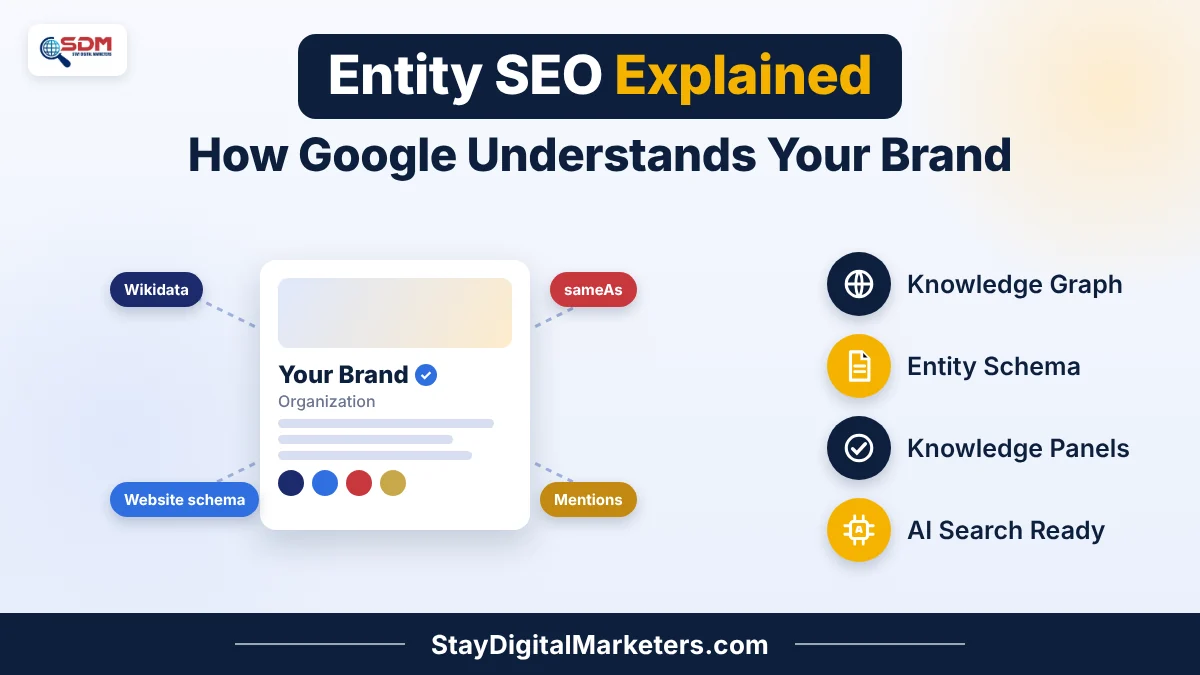
Entity SEO is the practice of helping search engines recognise a brand, person or product as a distinct, well-defined thing, an entity, and connect it to the right facts, people and topics. A Google Knowledge Panel is the most visible result of that work: the information box Google shows when it is confident it understands who or what a search is about.
Google has said its Knowledge Graph holds more than 500 billion facts about five billion entities, gathered from hundreds of sources across the web. This guide explains how Google builds that understanding, which signals shape it, and the step-by-step process any brand or founder can follow to become an entity Google trusts enough to display.
Key Takeaways
Entity SEO optimises how search engines identify and describe a specific thing, rather than how a page ranks for a string of keywords. An entity can be a company, a founder, a product, a place or a concept, as long as it is unique and can be described with facts.
Google announced the Knowledge Graph in 2012 under the phrase “things, not strings”. The idea was simple: instead of matching words on pages, Google would store facts about real-world things and the relationships between them. A search for a company name then becomes a lookup of a known entity, with its founder, location, products and official profiles already connected.
Keyword SEO targets queries; entity SEO targets understanding. Both matter, but they answer different questions.
The two approaches meet in topical authority. A site that covers its subject in depth, with clear connections between pages, also helps Google link the brand entity to that subject, as explained in this guide to building topical authority.
Google combines information from many sources, checks whether those sources agree, and stores the facts it trusts in its Knowledge Graph. Consistency across independent sources is what turns a name into a recognised entity.
In a May 2020 explanation of the system, Google’s Public Liaison for Search, Danny Sullivan, described how the Knowledge Graph and knowledge panels work. Facts are gathered automatically from hundreds of sources, including Wikipedia, licensed data and structured markup published by content owners, and automatic systems try to stop inaccurate facts from appearing.
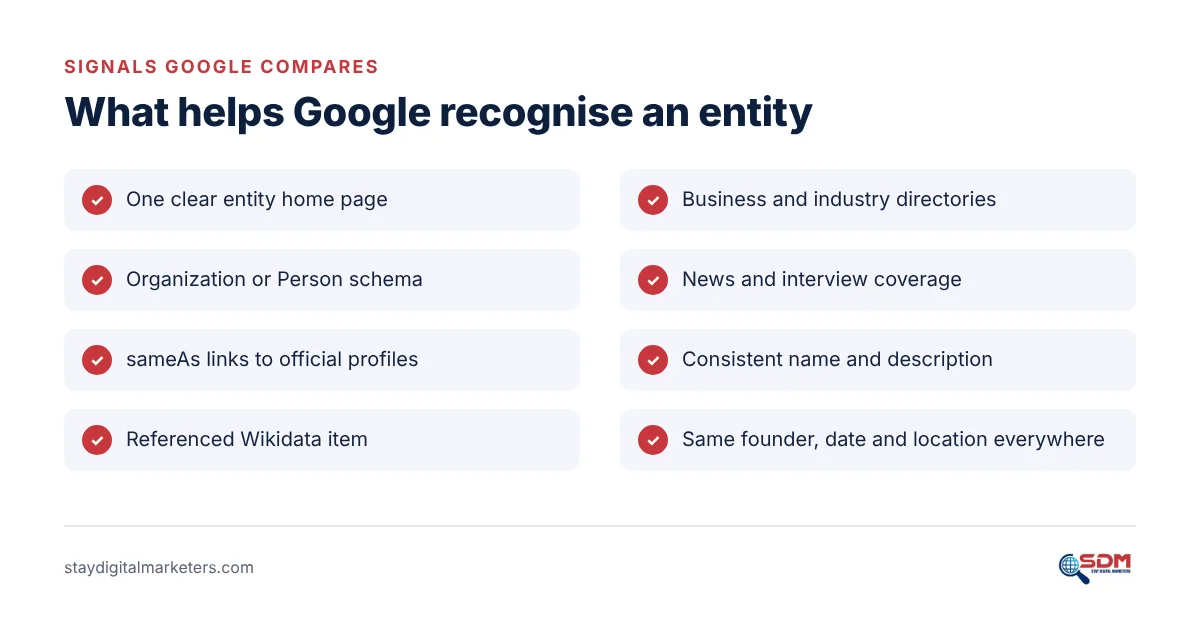
A Knowledge Panel is the box of facts Google shows beside or above search results when it recognises the entity behind a query. It typically includes a name, description, image, official links, key facts and related entities.
Knowledge Panels are generated automatically. No one can buy one, and no one can create one directly in a Google account. What a brand can do is build enough clear, consistent and corroborated information that Google is confident displaying it. Once a panel exists, the entity can often claim it and suggest corrections.
A Business Profile is a listing a local business creates and manages for its location; a Knowledge Panel is generated by Google for entities such as companies, people, organisations and creative works. Google’s own help pages direct businesses that serve customers at a location or in a service area to use a Business Profile. Brands without a storefront, founders, authors and online companies rely on the Knowledge Graph route instead.
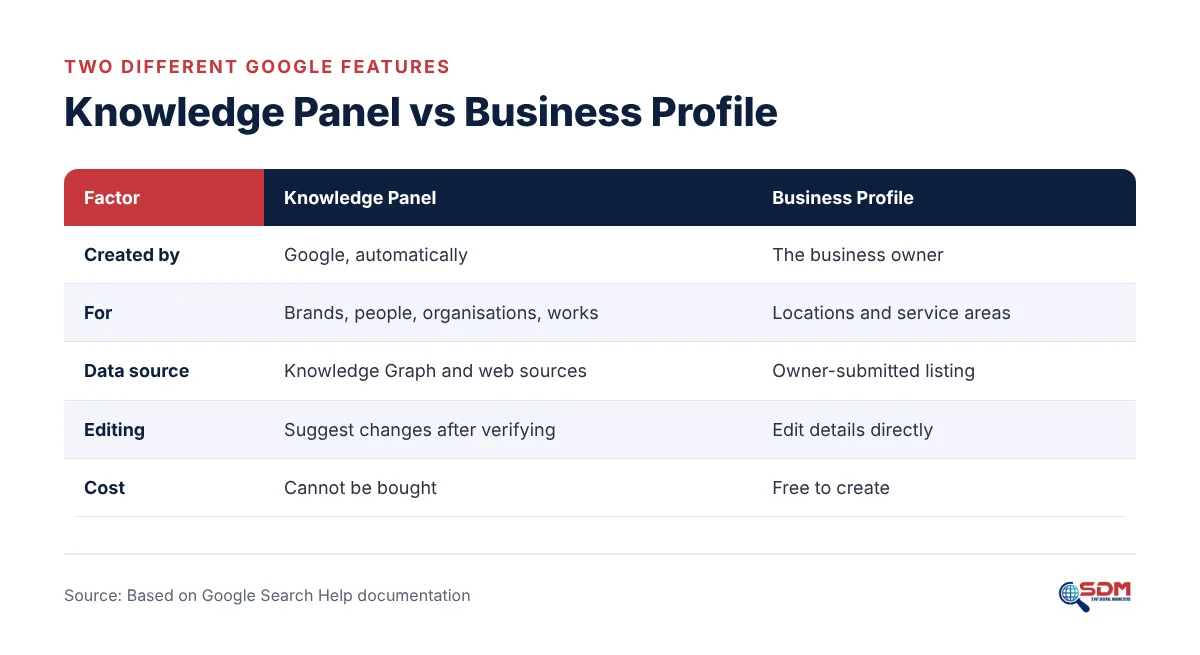
Google shows panels for many entity types, and each type relies on slightly different sources. Knowing which type applies helps decide which signals to build first.
A founder and a company are separate entities. Each needs its own clear description, and the connection between them, such as the founder property in Organization schema and the employer or founded-by statement in Wikidata, helps Google understand both. Many founders find their personal panel appears first, because interviews and bylines name them more often than the company.
Start with one authoritative entity home, describe the entity in structured data, then build consistent confirmation across trusted external sources. The Entity Trust Ladder below sets the order, because each rung relies on the one beneath it.
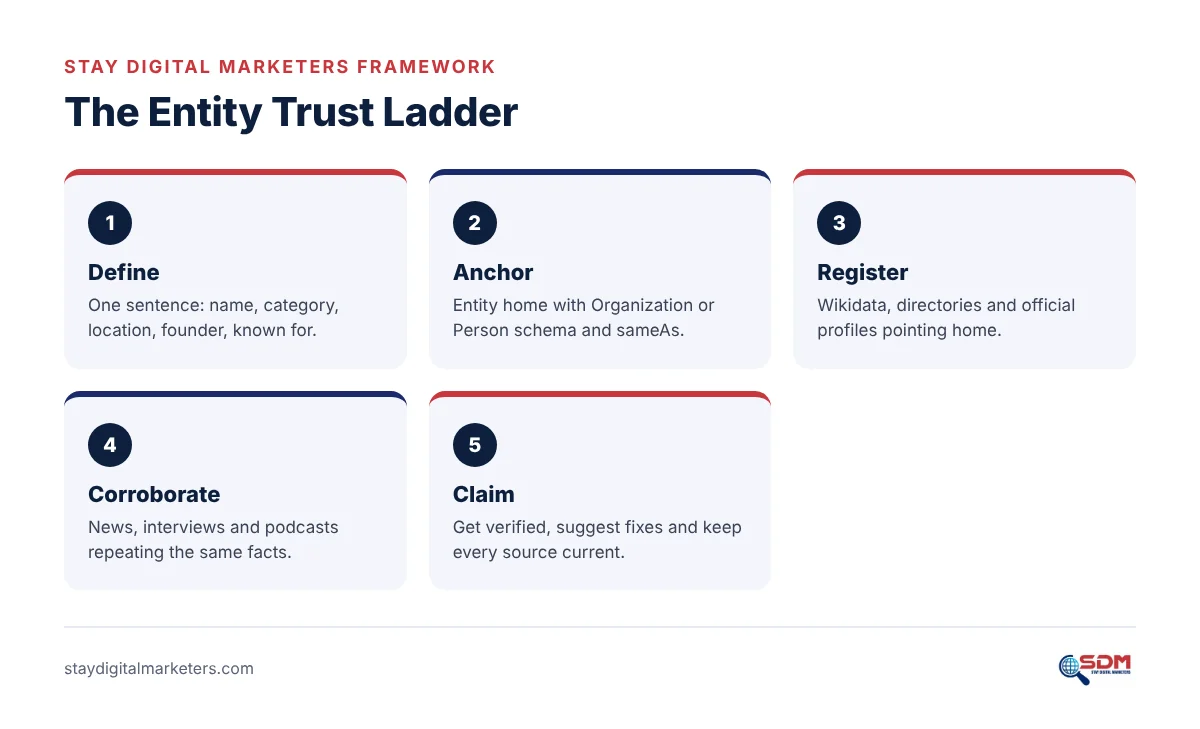
A pattern observed across client work is that most failed panel attempts skip rung one. The brand’s name, tagline and founder details differ between the website, LinkedIn, directories and press coverage, so Google sees several weak candidates instead of one strong entity. Fixing the description first usually speeds up every later step.
An entity home is the single page you want Google to treat as the official source of truth about the entity. For a company it is usually the About page or homepage; for a founder, an author page or personal site.
Every external profile should then link back to this page. That two-way loop, from the entity home out to profiles and from profiles back home, is what lets Google connect separate mentions into one entity. Keep the page updated whenever a fact changes, because an outdated entity home teaches Google outdated facts.
Use Organization schema for a brand or Person schema for an individual on the entity home, and connect official profiles with the sameAs property. Schema does not create a panel on its own, but it gives Google a clean, machine-readable summary to compare against other sources.
Google’s guidance on Organization structured data explains the properties it reads, including name, logo, URL, description, contact details and sameAs. Keep the markup on one canonical page, avoid duplicate Organization blocks from multiple plugins, and make every value match what is visible on the page.
Teams that want a ready-made starting point can generate Person, Organization and sameAs markup with a free entity schema generator, then test the result before publishing.
Test the finished markup with Google’s Rich Results Test and the Schema.org validator before it goes live. The wider principles are covered in this complete guide to schema markup.
Wikidata is a free, structured knowledge base that many search and AI systems read, so an accurate Wikidata item is one of the strongest third-party entity signals a brand can have. Each item has a unique identifier, called a QID, and stores facts as statements with references.
Wikidata has its own notability rules. An item needs to describe a clearly identifiable entity and be supported by serious, publicly available references, or be needed to make statements on other items. Items created purely for promotion, without references, are often deleted. Add only facts that independent sources confirm, and cite them.
No. Wikipedia is an important source, but Google has said it is not the only one, and many brands and individuals have panels without a Wikipedia article. Wikipedia’s notability bar is high, and an article created without independent coverage is likely to be deleted. The key differences are set out in this comparison of a Wikipedia page and a Knowledge Panel.
Independent mentions confirm that the entity is real and describe what it is known for, while links help Google discover and connect those sources. Both work best when they repeat the same core facts.
Mentions without links still help, because search engines can recognise entity names in text. The relationship between mentions, citations and authority is explained further in this guide to brand mentions in SEO.
Search for the entity on Google, select the option to claim the panel, and sign in with an official account Google associates with the entity. Google’s help centre lists YouTube, Search Console, X and Facebook as accounts it can use to confirm identity.
Verification does not give direct editing rights. Changes are suggestions that Google reviews, and verified managers can add or remove other users. Not every panel is claimable yet, and local businesses are directed to manage a Business Profile instead.
Correct the source first, then send feedback to Google with links that prove the right fact. Google pulls facts from external sources, so a wrong founding date that still appears on a directory or old press release can return after a correction.
Persistent errors usually mean several sources still disagree. More options for stubborn cases are covered in this guide on how to remove incorrect information from a Knowledge Panel.
Yes, as a monitoring tool. Google’s Knowledge Graph Search API lets developers look up entities by name and see whether Google has a Knowledge Graph ID for them, along with a short description and result score. It does not show everything Google knows, and Google notes it is not suitable as a production database, but it is a useful way to confirm that an entity exists and track how its description changes over time.
A practical routine is to check the brand and its founder once a month, record whether each returns an ID and description, and compare the description with the one-sentence definition from the Entity Trust Ladder. When Google’s description starts matching your own wording, the entity work is taking hold.
AI answer engines rely on the same need for clear, consistent entities, so brands that are well defined across trusted sources are easier for AI tools to describe and recommend. When a model is asked about a company, it draws on what the web consistently says about it.
Inconsistent descriptions create inconsistent answers. A brand described as an agency on one site, a software tool on another and a freelancer on a third gives both Google and AI systems conflicting evidence. The same one-sentence definition, repeated across the entity home, schema, profiles and coverage, is one of the simplest ways to improve how AI tools describe a brand.
Ask the main AI assistants the same set of questions every month and record the answers. A simple test set covers the questions buyers and journalists actually ask.
Compare each answer with the entity definition. Wrong founders, outdated services or confusion with a similarly named company point to the sources that need fixing. Answers that cite your entity home, Wikidata item or recent interviews show the signals are being read. Repeating the test after each round of updates turns entity SEO from guesswork into a measurable process, and the same records double as evidence when you request corrections from Google.
Most brands need several weeks to several months, depending on how much independent coverage already exists. A founder with existing press, interviews and profiles can move quickly once the entity home and schema are fixed. A new brand with no third-party mentions needs time to earn them.
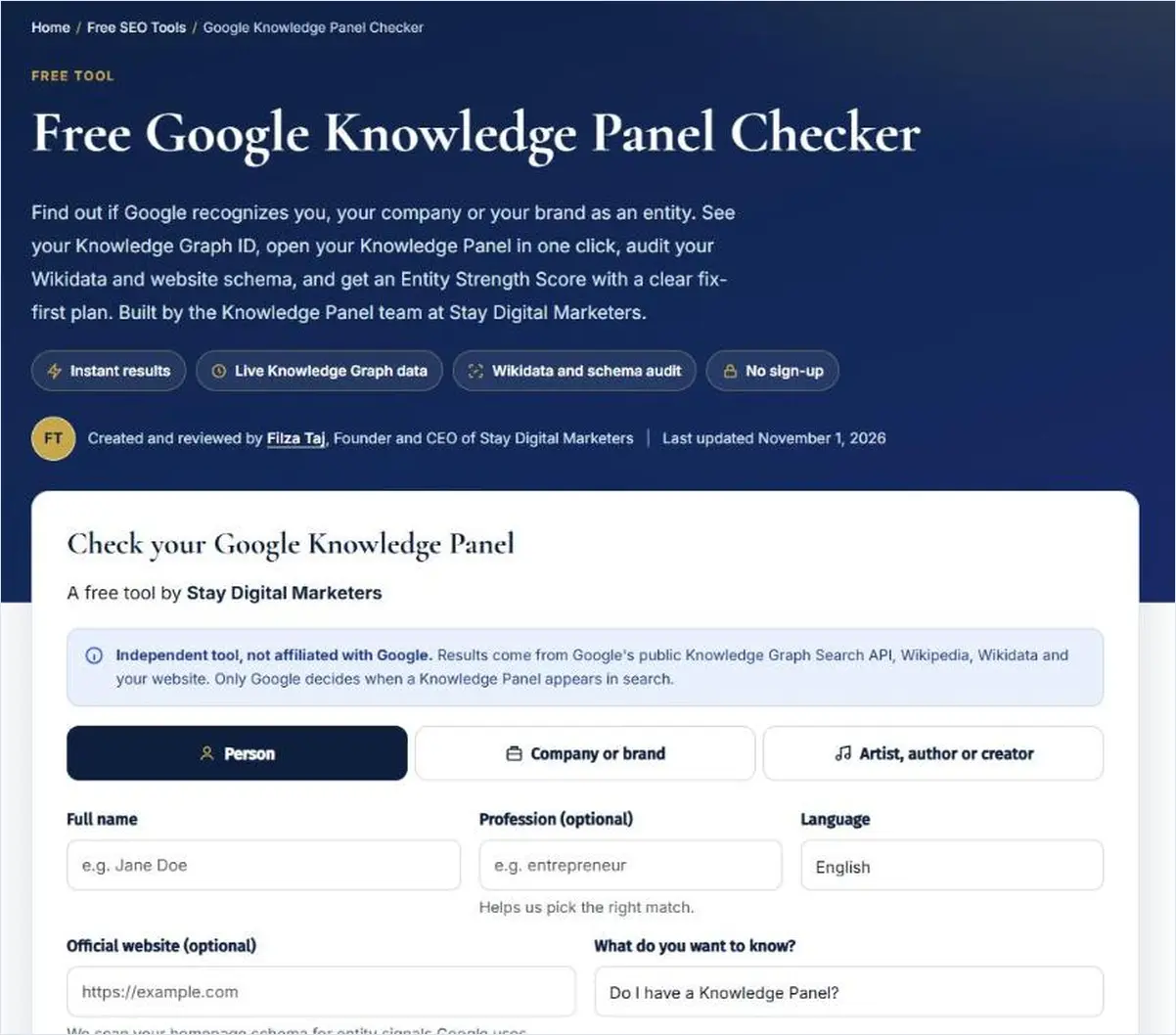
Track progress by searching the brand name in an incognito window, checking whether Google shows a panel or entity carousel, and testing whether the entity appears in Google’s Knowledge Graph. A free Google Knowledge Panel checker shows whether an entity has a Knowledge Graph ID and which signals are missing.
The most common mistakes are inconsistent facts, missing or duplicated schema, promotional Wikidata items, and trying to shortcut the process with paid placements. Each one weakens the confidence Google needs before displaying a panel.
An entity is a unique, well-defined thing that search engines can recognise and describe with facts, such as a company, person, product, place or concept. Google stores entities and their relationships in its Knowledge Graph, which it uses to understand searches and display Knowledge Panels for recognised entities.
No one can create a Knowledge Panel directly. Google generates panels automatically when it is confident about an entity. You can make that more likely by building a clear entity home, adding accurate schema, creating referenced Wikidata records and earning consistent independent coverage, then claiming the panel once it appears.
Schema markup alone does not create a Knowledge Panel. It gives Google a clean, machine-readable description of the entity to compare with other sources. Panels appear when structured data, official profiles, trusted databases and independent mentions all agree on who the entity is and what it does.
Google said in May 2020 that its Knowledge Graph had amassed more than 500 billion facts about five billion entities. Those facts come from hundreds of sources across the web, including Wikipedia, licensed data and structured markup that content owners publish on their own websites.
Yes. AI answer engines draw on how consistently the web describes a brand. A clearly defined entity with matching facts across its website, schema, profiles and independent coverage is easier for AI tools to identify, describe accurately and recommend when users ask about its category or services.
Brands and founders who want help building a recognised entity can work with Stay Digital Marketers, a resource that helps with guest posting, press release distribution, SaaS backlinks, niche edits, multilingual backlinks, Wikipedia page creation, Google Knowledge Panel creation and complete SEO services.

Filza Taj is an MPhil in Human Resources-turned SEO Specialist, Content Strategist, and Digital Marketing Consultant with over 5 years of experience helping businesses in 30+ countries grow online. As the Founder of Stay Digital Marketers (staydigitalmarketers.com), she delivers results-driven solutions in link building, guest posting, PR distribution, niche edits, multilingual backlinks, and content marketing. She publishes daily SEO insights and actionable strategies to help brands strengthen their online presence, attract the right audience, and convert clicks into loyal customers.
Filza@staydigitalmarketers.com
Stay Digital Marketers
Grow Your Brand on Google, in AI Answers and on Autopilot
SEO, Link Building and AI Automation by Stay Digital Marketers
Get Your Growth Plan →